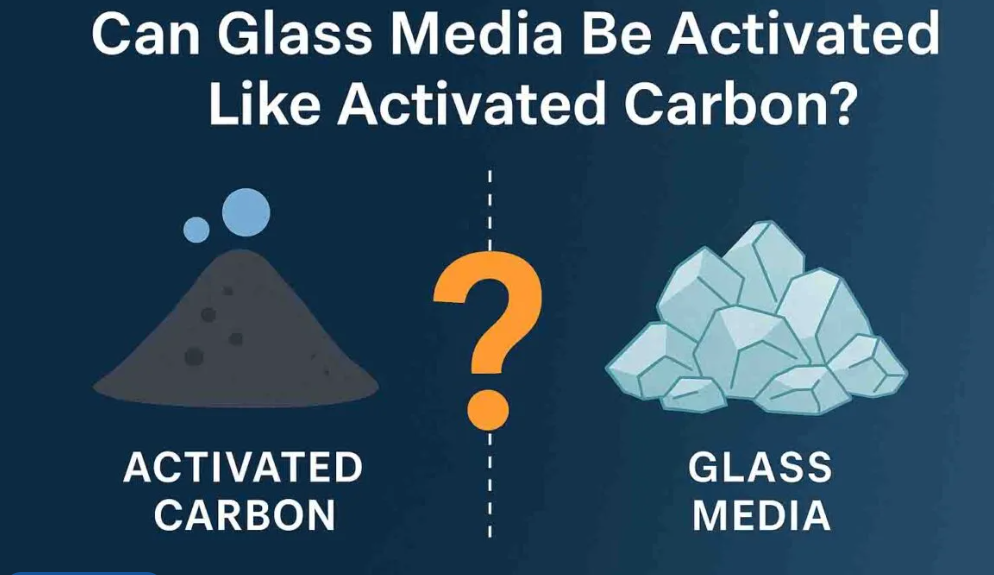
Can Glass Media Be Activated Like Activated Carbon?
1. What is Glass Filter Media?
Glass filter media consists of angular particles produced from 100% recycled glass (e.g., bottles, jars) through crushing, melting, cooling, and screening. It serves as a high-performance physical filtration medium, designed as a superior alternative to traditional quartz sand, and is widely implemented in:
-
Municipal Water Supply: Advanced treatment units.
-
Swimming Pools & Landscape Water: Recirculation filtration systems.
-
Industrial & Wastewater Treatment: Pre-treatment or tertiary filtration stages.
Key Advantages:
-
Superior Filtration Precision: Effectively filters particles down to 5-10 microns (sand typically filters to 20-25 microns).
-
Higher Operational Efficiency: Its smoother surface and slight negative charge (ζ-potential) reduce clogging, lowering backwash frequency by ~30-50% and saving water/energy.
-
Extended Service Life: Chemically inert and highly wear-resistant, with a lifespan of 10-15 years—2-3 times longer than sand media.
-
Eco-Friendly Profile: Manufactured from post-consumer recycled glass, reducing resource extraction and environmental impact.
2. What is Activated Carbon?
Activated carbon is an ultra-porous material created by subjecting carbon-rich sources (like coconut shells or coal) to high-temperature pyrolysis (>800°C) followed by activation (using steam or chemicals). This process yields an immense internal surface area (1 gram can equal a football field), which captures contaminants primarily through chemical adsorption (van der Waals forces).
Key Advantages:
-
Powerful Chemical Adsorption: Highly effective at removing residual chlorine, odors, color, volatile organic compounds (VOCs), certain heavy metals, and organic pollutants.
-
Broad Application Scope: An essential medium for drinking water purification, air filtration, decolorization, and chemical recovery processes.
Technical Focus: The Truth About "Activated" Glass
Short Answer: It's a different process and largely a marketing term.
| Characteristic | Activated Carbon "Activation" | Glass Media "Treatment" |
|---|---|---|
| Process Essence | Pore Creation: Forms a nanoscale network of internal pores via high heat/chemical etching. | Surface Modification: Roughens the surface or alters surface charge (ζ-potential) via acid/mechanical means. |
| Structural Change | Internal Transformation: Creates an ultra-high specific surface area (500-1500 m²/g). | Superficial Change: Minimally increases surface area; no internal pore network is created. |
| Core Mechanism | Chemical Adsorption: Pollutants are trapped inside pores by intermolecular forces. | Physical Sieving & Weak Adsorption: Relies on size exclusion and slight electrostatic attraction. |
| Target Contaminants | Molecular-Level: Chlorine, benzene, pesticides, taste/odor compounds. | Particulate-Level: Sediment, rust, colloids, some microorganisms. |
| Truly "Activated"? | ✅ YES – Creates a fundamentally new adsorbent structure. | ❌ NO – It is an enhanced physical filter, not a chemical adsorbent. |
Conclusion: Labeling glass as "activated" is highly misleading, as it incorrectly implies carbon-like chemical removal capabilities. Treated glass remains a physical filtration media.
Performance Comparison: Glass Media vs. Traditional Sand
For physical filtration applications, glass media represents a clear technological upgrade:
| Characteristic | Quartz Sand Media | Glass Media | Advantage of Glass |
|---|---|---|---|
| Filtration Precision | ~20-25 microns | ~5-10 microns | 2-4x finer filtration, clearer effluent. |
| Backwash Frequency | Higher (every 1-2 weeks) | Lower (every 3-4+ weeks) | Saves water & energy, less maintenance. |
| Service Life | 3-5 years | 10-15 years | Lower long-term cost. |
| Biofilm Tendency | Rough surface promotes growth | Smooth surface inhibits growth | More hygienic, reduces biocide demand. |
| Bulk Density | Higher | Lower | Better media fluidization during backwash. |
| Sustainability | Virgin mined material | 100% Recycled Content | Closed-loop solution, reduces footprint. |
Conclusion: Upgrading from sand to glass media is a smart investment for achieving better filtration, reduced maintenance, and enhanced sustainability.
System Design: Optimal Media Combination Strategies
Complex water quality demands a multi-stage approach. Combining media maximizes system effectiveness:
-
The "Glass + Activated Carbon" Standard:
-
Stage 1 (Glass): Pre-filtration. Removes particulates to protect downstream media from fouling.
-
Stage 2 (Activated Carbon): Polishing. Adsorbs chemicals, chlorine, and improves taste/odor.
-
Ideal For: Residential POE/POU systems, food/beverage processing water, premium pools.
-
-
The "Glass + Softening Resin" Combo:
-
Glass pre-filtration prevents resin bed clogging by removing suspended solids.
-
Perfect for hard water applications requiring both clarification and softening.
-
-
Advanced "Sand → Glass → Carbon" Sequence:
-
A robust multi-barrier approach for municipal or industrial treatment, enabling progressive removal of solids, fine particles, and dissolved contaminants.
-
Selection Guide: Choosing the Right Media
| Your Primary Goal | Recommended Media | Key Reasoning |
|---|---|---|
| Clarify Water (Pools, Pond) | ✅ Glass Media | Superior physical filtration, longevity, and low maintenance. |
| Remove Taste, Odor, Chemicals | ✅ Activated Carbon | The only choice for effective chemical adsorption. |
| Whole-House / Drinking Water | ✅ Combined System | Glass (pre-filter) + Carbon (core) + Membrane (polish) for comprehensive treatment. |
| Industrial Pre-Treatment | ✅ Glass Media | Excellent solids removal, protects sensitive downstream equipment (e.g., membranes). |
| Maximize Eco-Efficiency | ✅ Glass Media | Long life cycle and 100% recycled content minimize environmental impact. |
Simple Rule: Use glass to remove particles you can see. Use activated carbon to remove chemicals you can taste or smell. Use them together for complete protection.
RELATED NEWS
CATEGORIES
LATEST NEWS
CONTACT US
Name: Joy
Mobile:WhatsApp +86-15615531918
Tel:+86-15615531918
Whatsapp:+86 15615531918
Email:joy@onlyzone.cn
Add:Building 25-1, 333 Sanying Road, Zibo City, Shandong Province, China